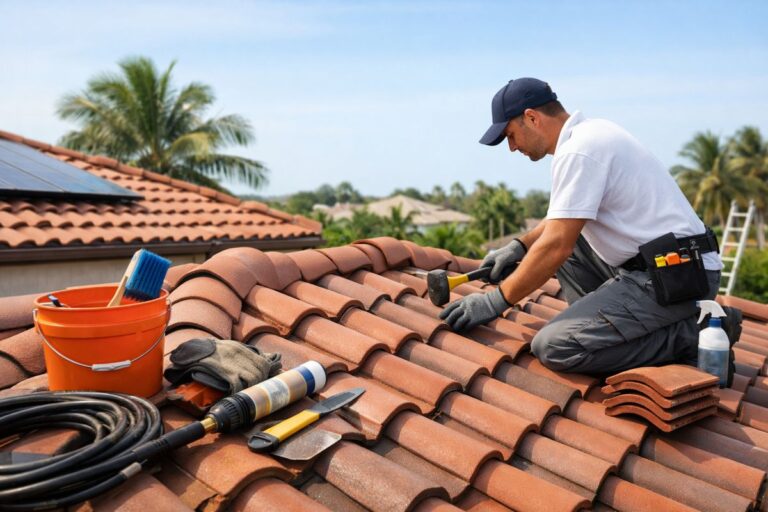
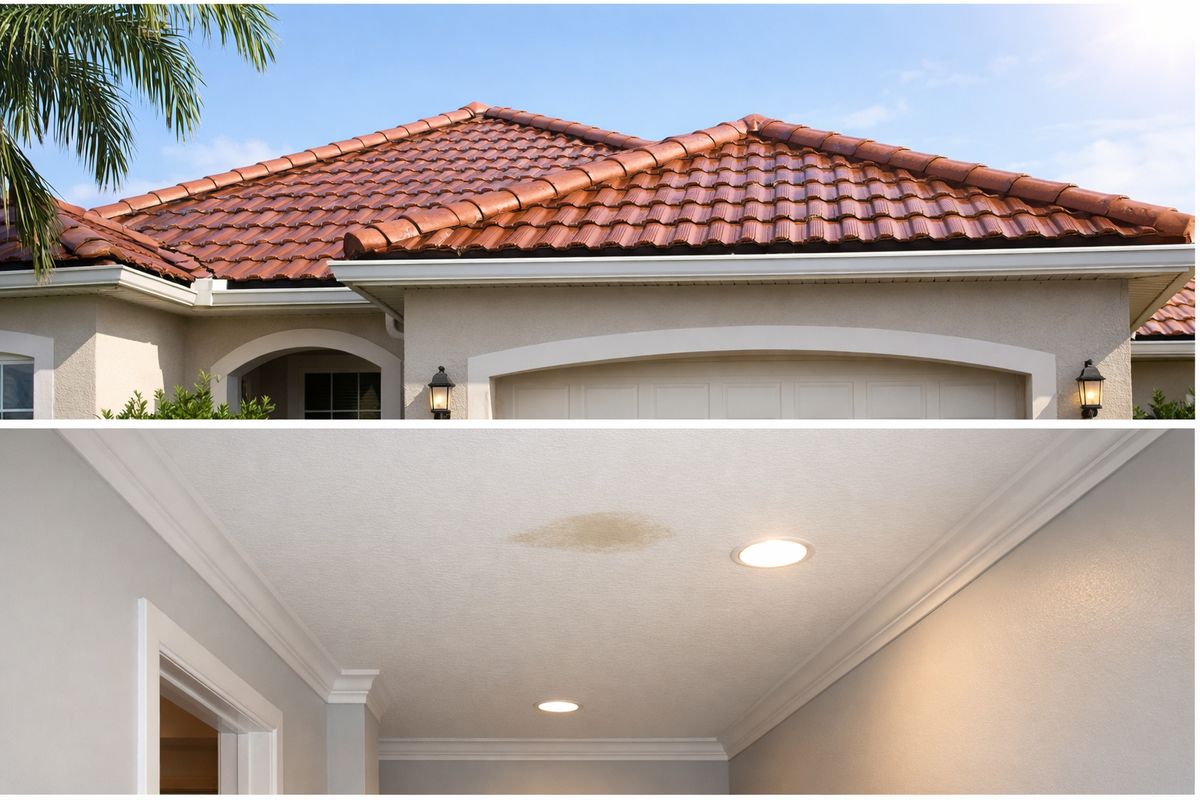
A tile roof can look solid from the street and still be one hard Florida downpour away from a ceiling stain in the hallway. That is why tile roof maintenance matters so much here: not because tile is weak, but because Florida is relentless, and it will test every seam, flashing edge, fastener, and underlayment lap long before the roof looks old.
A tile roof is not one waterproof shell. It is a water-shedding system made of tiles on top and backup protection underneath, with metal flashings, vents, fasteners, drainage paths, and attic airflow all working together. If you understand that one idea, the rest of this guide gets much easier.
Here’s what you’ll learn in this guide:
- What actually wears out on Florida tile roofs
- How to inspect your roof without causing damage
- What warning signs mean trouble now
- How often to clean, check, and service the roof
- Which repairs can wait, and which cannot
- How storms, salt air, and heat change maintenance
- When to call a licensed Florida roofing contractor
- What maintenance usually costs
- How to extend roof life without wasting money
Why Tile Roof Maintenance Matters More in Florida
If you have ever spotted a faint brown ring on a ceiling after a summer storm in Tampa, you already know how fast a roof problem can go from invisible to very real. Florida tile roofs are durable, often impressively durable, but that durability gets misunderstood. The tile itself may last for decades, yet the roof system beneath it takes a beating every single year.
Here’s the direct claim: Florida will find every weak spot fast. A tiny crack, one slipped tile, a rusted flashing corner, or a clogged valley can stay quiet for a while in a milder climate. In Florida, daily rain, UV exposure, humidity, and storm winds push those small issues into active leaks much sooner.
That is why maintenance is not really about babying the tiles. It is about protecting the whole roof system before water gets past the outer layer and reaches wood decking, attic insulation, drywall, paint, and flooring. Once you see damage indoors, the problem is already further along than most people think.
The Florida conditions that speed up roof wear
Florida is hard on roofs in ways brochures tend to gloss over. Sun is the obvious one. Constant UV exposure dries out sealants, ages exposed edges, fades coatings, and slowly weakens materials that are supposed to stay flexible. Then the temperature swings take over. Even if the swing is not dramatic like a northern freeze-thaw cycle, repeated heating and cooling still causes expansion and contraction in metal, sealants, and underlayment.
Humidity adds another layer of trouble. Moist air lingers, especially in shaded areas and along coastal zones, which helps algae, mildew, and moisture retention take hold. Then come the daily summer rains. Water tests roof edges, valleys, penetrations, and drainage paths again and again, and it only takes one vulnerable spot for that routine to become expensive.
Wind is the real accelerant. Tropical storms and hurricanes do not just rip off obvious pieces. They can loosen tiles, shift ridge components, stress flashings, and push rain uphill under laps where it would not normally go. Florida roofs often show aging and warning signs much earlier than owners expect, sometimes within 8 to 12 years, even when the roof still looks decent from the curb.
Tile lasts a long time, but the system underneath often doesn’t
This is the part that surprises a lot of homeowners. Tile can outlast the parts below it. On many Florida homes, the underlayment, flashing, fasteners, and seals begin to fail before the field tile is anywhere near the end of its life.
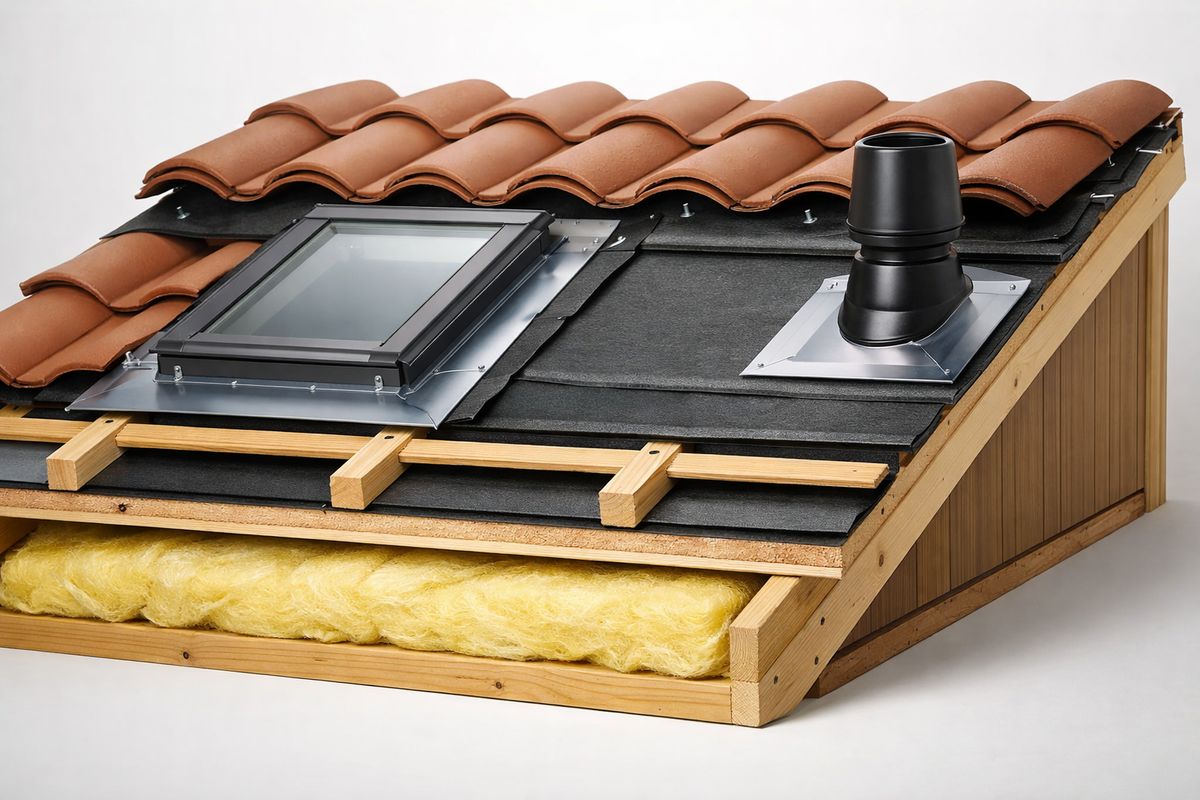
Think of your roof system like layers of protection. The tile sheds most of the water and absorbs a lot of weather exposure. Under that sits the underlayment, which is the backup water barrier. Around edges, walls, chimneys, skylights, pipes, and valleys, flashing directs water away from vulnerable transitions. Fasteners keep components secure. Ventilation helps control heat and moisture so the whole system lasts longer. Decking supports everything.
That is why a tile roof can look mostly fine from the street and still need serious work. In Florida, roof life is often less about the tile surface and more about what is happening underneath. Sources on Florida roof performance regularly note that the earliest trouble often starts in underlayment, flashing, or fasteners, not the tile itself.
Understanding Your Tile Roof System
If you want maintenance to make sense, start here. A tile roof does not work like a giant waterproof plastic lid. It works by shedding water down and off the roof while the layers beneath handle whatever gets past the outer surface.
That matters because some water intrusion under tile is expected in harsh weather. The real question is whether the backup layers and drainage details are still doing their job. When those fail, leaks show up.
Clay vs. concrete tile in Florida
Clay and concrete tile both make sense in Florida, but they are not the same thing. Clay tile usually lasts longer, keeps its color well, and has that classic look people picture in coastal or Mediterranean-style neighborhoods. It can sometimes last 50 to 100 years or more in ideal conditions. Concrete tile is typically more affordable, easier to source, and still very durable, often lasting 30 to 50 years or longer when installed and maintained well.
Concrete tends to be heavier-looking and can absorb a bit more moisture at the surface. Clay is often a little more brittle but highly durable over the long haul. In practice, your maintenance routine is similar for both: watch for cracked tiles, slipped pieces, worn flashings, clogged valleys, and underlayment issues.
The bigger difference is often matching and repair strategy. If you own an older home, especially one with older clay tile, finding a clean material match can be much harder than fixing the leak itself. That is one reason it helps to understand how the two tile types differ in Florida conditions before repairs become urgent.
The parts of a tile roof that need attention
Your roof has more working parts than most people realize. The field tiles are the visible surface. Ridge caps and hip tiles protect the high lines and intersections where roof planes meet. Valleys are the channels where water concentrates and rushes downward during rain. Flashing seals transitions around walls, chimneys, skylights, vent pipes, and roof edges.
Under the tile sits the underlayment, which does a lot of the real leak prevention when storms get messy. Battens, if your roof uses them, help support and space the tile. Fasteners keep components attached. Vents support attic airflow. Gutters and downspouts move water away from the roof edge and foundation. Soffits and fascia protect roof edges and help with ventilation and drainage control.
When one of those parts fails, the damage often spreads sideways. A clogged valley can back water into flashing. Failed flashing can wet the underlayment. Wet underlayment can leak onto decking. Wet decking can lead to attic moisture and stained drywall. Roof problems rarely stay polite.
Why tile roofs leak even when most tiles still look fine
Because the leak usually starts somewhere less obvious. A roof can have 95 percent of its tiles in good shape and still leak around one pipe boot, one valley seam, one cracked ridge cap, or one section of brittle underlayment.
Florida also adds wind-driven rain, which changes the game. Water is no longer just falling downward and sliding off. It gets pushed sideways and upward into joints and transition points. That is why leaks so often show up around skylights, chimneys, vent penetrations, valleys, and wall intersections.
Another common scenario is tile movement after storms. Tiles can shift just enough to expose underlayment or create a channel for water. Visible damage signs such as cracked, slipped, or missing tiles matter because even a small opening can expose the layers below to Florida’s rain and humidity within days.
The Biggest Threats to Tile Roofs in Florida
Florida roofs do not usually fail from one dramatic cause alone. More often, they get worn down by a mix of weather, age, drainage issues, and delayed repairs. Knowing the main threats helps you spot patterns instead of just random symptoms.
Hurricanes and tropical storms
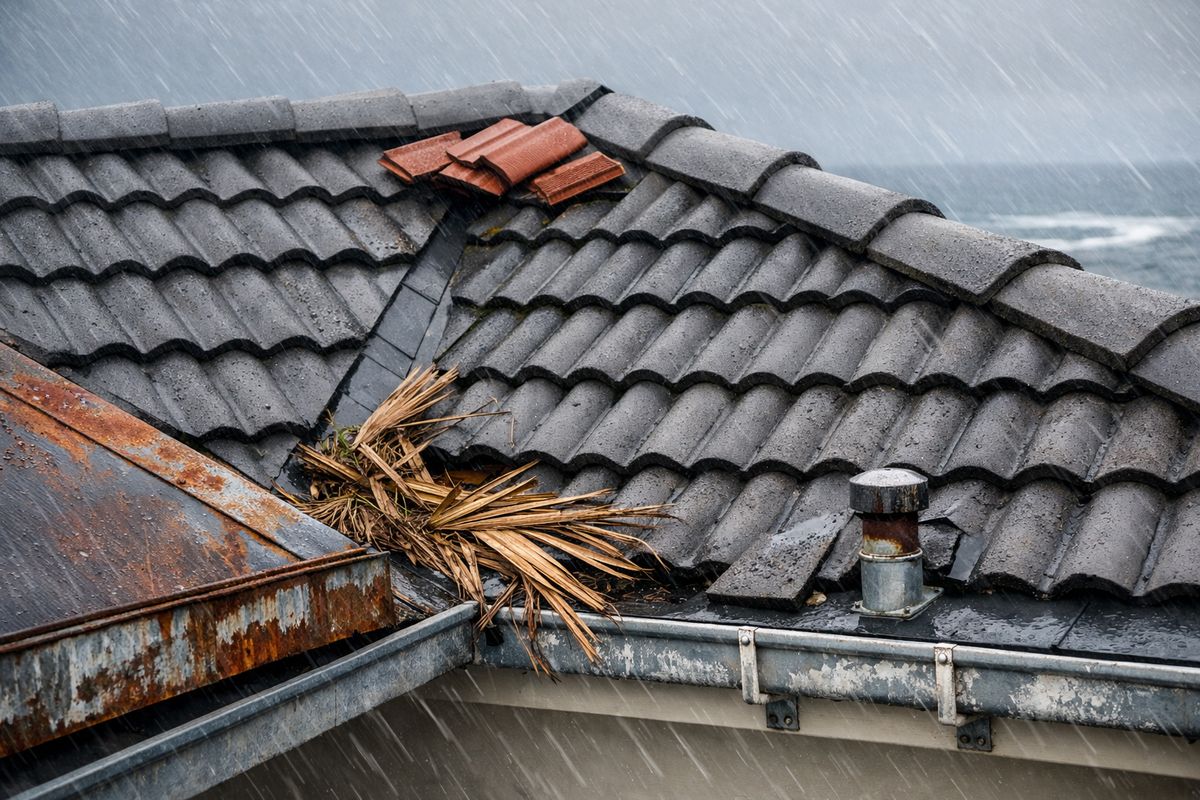
Storms do the obvious damage, like broken or missing tiles, but the subtle damage is often what gets missed. Wind uplift can loosen tiles without throwing them into the yard. Debris can chip corners and crack edges. Wind-driven rain can push water beneath tile laps and stress the underlayment long before a leak appears in the living room.
After a storm, damage may be limited to one slope, one valley, or one penetration. That is the catch. If you only look for dramatic destruction, you miss the problems that keep working quietly until the next storm hits.
Even small detached areas can leave surrounding sections more vulnerable in the next event, especially under Florida’s wind-uplift expectations for roofing systems. Early repair matters because one storm often sets up the next problem.
Salt air and coastal corrosion
If your home sits near the Gulf, Atlantic, bay, or even a few miles inland in a salty environment, metal parts deserve extra attention. Salt air speeds corrosion on flashing, fasteners, clips, vent components, and other metal accessories.
Tiles usually get the credit for durability, and fair enough, but the metal details are often what fail first near the coast. Rusted fasteners can loosen attachments. Corroded flashing can separate or thin out at seams. Once that happens, water finds a path.
Coastal roofs need a faster inspection rhythm. Not panicked. Just tighter.
Heat, UV, and thermal expansion
Florida heat is relentless, especially on dark or sun-blasted roof slopes that bake all afternoon. Tile handles heat well, but the materials around it still age. Sealants dry out. Underlayment near exposed edges gets stressed. Metals expand and contract, which can slowly pull at fastener points or seams.
This kind of wear is easy to ignore because it happens gradually. Yet the result is very real. A roof that looked fine for years can suddenly start leaking once one overstressed detail finally gives way.
Heavy rain, humidity, and trapped moisture
Rain alone is not the whole issue. Rain plus humidity plus shade plus blocked drainage is where trouble starts to compound. Moisture can get trapped beneath debris, under loosened tiles, or inside poorly ventilated attic spaces. Once water reaches drywall, mold can begin surprisingly fast, often within 24 to 48 hours.
That is why a small ceiling stain should never be treated like a cosmetic issue. It is a message that the roof’s outer defenses already failed somewhere upstream.
Debris, trees, and clogged drainage
Leaves, pine needles, seed pods, and small branches are not dramatic, but they do real damage over time. Valleys act like funnels, and if debris builds there, rainwater slows down or dams up. Then the water looks for another path, usually under tile edges, around flashing, or over fascia.
Trees also add abrasion. Branches rubbing against tile can wear surfaces or knock pieces loose in a storm. Heavy shade keeps roof sections damp longer, which encourages algae and biological growth. It is a little like leaving a wet towel bunched in the corner instead of hanging it up. Nothing good comes from that.
A Safe Tile Roof Maintenance Mindset
Some roof tasks are worth doing yourself. Some are absolutely not. The trick is knowing the line before you cross it.
Why walking on tile is risky
Walking on tile sounds simple until you do damage you cannot even see from where you stepped. Tiles can crack, shift, or loosen under uneven weight, especially older tiles or brittle pieces baked by years of heat. One wrong step can create a leak path without leaving a dramatic visual clue.
There is also the obvious personal safety issue. Roof work is dangerous, and falls remain the biggest hazard in roofing. Consumer safety data on roofing injuries points overwhelmingly to fall-related risk, which is reason enough to keep casual DIY roof walking off the list.
Even trained crews take precautions on tile. Historic preservation guidance for clay tile repair recommends limiting foot traffic, using appropriate access methods, and protecting surrounding materials because tile damage from careless movement is so common.
What you can check from the ground
You can catch a lot without ever stepping onto the roof. Start with a habit of looking up after storms and after long stretches of rain. Use binoculars to scan for slipped tiles, cracked edges, uneven lines, missing ridge pieces, or debris packed into valleys. That kind of ground-level inspection is one of the smartest low-risk checks you can make.
Inside the house, watch ceilings for stains, bubbling paint, and small texture changes. Pay attention to musty attic smells after rain. Notice if gutters overflow at one corner or if one downspout suddenly stops flowing like the others. Those small clues tell you where to look closer.
When a ladder is enough and when it isn’t
A ladder can be useful for edge checks, gutter views, and taking photos of eaves, fascia, and lower flashing details. That said, the minute a quick check starts tempting you onto the tile field, stop there.
If you need to inspect a valley high up, move loose tiles, clear central debris, test flashing, or look around penetrations near the ridge, that is no longer a ladder-only job. A broken tile and a broken ankle are a terrible combo, and both happen from the same kind of overconfidence.
When to call a licensed Florida roofing contractor
Call a pro when you see active leaks, ceiling stains, missing or slipped tiles, exposed underlayment, rusted or separated flashing, sagging sections, or storm damage of any kind. Also call when you need attic moisture diagnosis, insurance documentation, or repair planning for an older roof where underlayment may be the real issue.
Florida roofs are too exposed, and tile systems are too specialized, for generic guesses. If you need help choosing someone qualified, start with guidance on how to vet a properly credentialed Florida roofer. For tile in particular, experience matters even more than general roofing experience, because improper handling can create the very damage you were trying to prevent.
Your Florida Tile Roof Maintenance Schedule
Most roof advice stops at “inspect regularly,” which is not very useful. A real schedule makes maintenance doable.
Monthly quick checks
Once a month, take five to ten minutes and do a simple scan. Look at ceilings in rooms below roof slopes. Check for new stains, faint yellowing, bubbling paint, or damp-looking corners. Step outside and scan the roofline for debris piles, visible tile movement, or pieces on the ground.
After a rain, notice how water leaves the roof. Are gutters overflowing at one spot? Is one valley holding debris? Is there splashback near fascia? These are easy patterns to miss if you only look in dry weather.
This kind of routine matters because early roof repair is usually much cheaper than waiting. Some Florida guidance estimates that prompt repairs can avoid $2,000 to $8,000 in interior damage.
Seasonal maintenance for Florida homes
Florida does not divide neatly into four classic seasons for roofing purposes. It helps more to think in weather patterns.
In the dry season, focus on cleaning, checking flashings, and dealing with repairs while schedules are less crowded. Before the rainy season, clear gutters, inspect valleys, trim back branches, and make sure attic ventilation is performing well. During hurricane season, keep the roof in ready condition, which means no known loose tiles, no packed debris, no delayed flashing repairs, and updated photo documentation. In cooler months, review what the storm season did and deal with anything that was temporarily patched.
A seasonal rhythm works better than random attention because Florida weather comes in waves. Your maintenance should too.
Post-storm inspections you should never skip
After high winds, hail, heavy rain, or flying debris, inspect the property as soon as it is safe. Start from the ground and use binoculars. Look for displaced tiles, fresh cracks, ridge damage, bent flashing, debris impact points, and anything unusual along valleys and edges.
Inside, check ceilings, upper walls, attic insulation, and the underside of the roof deck. Smell matters here. A musty odor after a storm is often your first clue before stains become visible.
Photograph roof slopes from several angles, close-ups of visible damage from safe positions, any debris impact, interior stains, wet insulation, and water marks around vents or skylights. Time-stamped photos help with repair planning and insurance discussions.
A simple checklist helps:
- Roofline from all sides
- Valleys and ridge areas
- Gutters and downspouts
- Ceiling stains or bubbling paint
- Attic moisture or damp insulation
- Fallen tile pieces in the yard
- Flashing around visible penetrations
- Tree limb impact areas
Annual professional inspection
At least once a year, get a professional inspection, and sooner if the roof is older, coastal, or recently storm-hit. A proper inspection should cover tile condition, ridge and hip components, valleys, flashing, penetrations, exposed underlayment areas if any, attic signs of leaks, ventilation performance, drainage paths, fascia, soffits, and general storm readiness.
A good contractor should provide photos, explain where the weak points are, and distinguish between cosmetic issues and actual leak risks. If you want a deeper sense of what a roof review should include, this overview of what a Florida roof check usually covers helps set expectations before someone climbs a ladder.
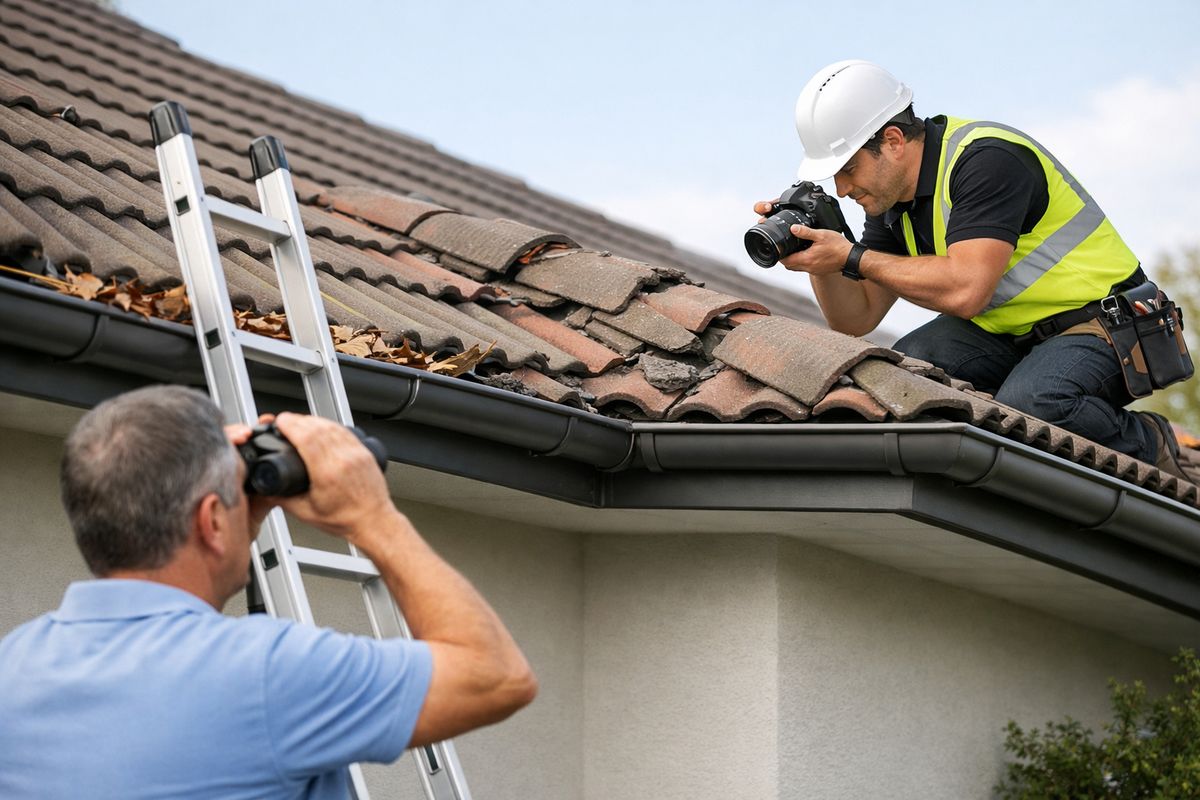
How to Inspect a Tile Roof Without Missing the Important Stuff
The best inspection order starts inside and works outward. That sounds backward, but it catches leaks earlier and keeps you safer.
Start inside: ceilings, walls, and attic clues
Begin with the rooms directly under the roof. Look for stains, yellowing rings, peeling paint, soft drywall, or trim discoloration. Small changes matter. Water often travels before it drips, so the stain may not sit directly under the roof problem.
Then check the attic, ideally during daylight and again after heavy rain. Look for damp insulation, darkened wood, mold spotting, musty smells, or sunlight peeking through the roof deck. If drywall has gotten wet, mold can start fast, so 24 to 48 hours is not the time to “see if it dries out.”
If you own a moisture meter, this is one place it actually helps. It can confirm that a suspicious stain is active rather than old.
Check roof edges, valleys, and penetrations
These areas fail first because they handle transitions, concentrated water flow, and complicated detailing. From a ladder at the eave or with binoculars from the ground, look for debris buildup in valleys, lifted flashing edges, rust streaks, cracked sealant around penetrations, and uneven tile alignment near walls or roof intersections.
Valleys should look clear and intentional. If one looks stuffed with leaves or pine straw, that is a maintenance issue, not just an eyesore. Penetrations like vent pipes and skylights deserve extra suspicion because every hole in the roof is a place that depends on flashing and seals staying intact.
Look for cracked, slipped, or missing tiles
Cracked tiles may show as a straight fracture, chipped corner, or subtle split line. Slipped tiles often look out of alignment, lower than surrounding pieces, or uneven along their course. Missing tiles are obvious, but even one missing piece can expose underlayment and speed up damage.
Do not dismiss a small problem because the rest of the roof looks okay. One opening is enough. Florida rain does not need a large invitation.
Don’t ignore flashing and sealant failure
Flashing trouble often shows up as rust, lifted edges, open seams, bent corners, or staining where water has been running where it should not. Sealants tell a story too. If they look brittle, split, shrunk, or separated from adjacent materials, their time may be up.
The problem is not just the sealant itself. Failed sealant usually means movement, age, or poor original detailing. Smearing on more caulk without addressing the underlying issue is a short-lived patch at best.
Watch gutters, downspouts, scuppers, and drainage paths
Drainage problems can mimic roof leaks or cause them outright. Gutters that overflow, scuppers that back up, or downspouts that drain poorly can force water into roof edges and fascia. Water does not care whether the failure is glamorous. If it can back up, it will.
Check for dark streaks, overflow marks, loose gutter sections, and plant growth in drainage areas. If water leaves the roof badly, the rest of the system pays for it.
The Most Common Warning Signs Your Tile Roof Needs Attention
Roof problems usually announce themselves in small ways first. The trick is knowing which signs are real warnings and which are mostly cosmetic.
Ceiling stains and interior moisture
A ceiling stain is never an outer-roof-only problem. By the time water marks show indoors, moisture has already moved past tile, underlayment, or flashing somewhere above. That means the roof’s backup defenses were involved too.
This is one of the clearest signs to act quickly. Waiting tends to turn a manageable repair into drywall work, insulation replacement, mold cleanup, or decking repair. Not exactly the kind of home project anyone wants to discover on a Tuesday evening.
Tile pieces in the yard or granules in drainage areas
If you find broken tile fragments after a storm or after someone has been on the roof, pay attention. Tile does not shed like asphalt, so pieces on the ground usually mean real physical damage, not just normal wear. The fragment shape can help too. Clean snapped edges suggest impact or foot traffic. Worn pieces may suggest age-related brittleness.
Look upslope from where you found the pieces. Damage is often close by, though not always directly above.
Sagging, soft spots, or uneven roof lines
A sagging roof line is urgent. It can point to wet or deteriorated decking, prolonged moisture intrusion, or deeper structural concerns. Even if the tile itself looks intact, the support below may not be.
From the ground, compare roof planes and ridges. If one area dips, bows, or looks uneven compared with surrounding lines, do not ignore it. This is one of those signs that should move straight to professional evaluation.
Rust stains, mildew streaks, and efflorescence
Rust streaks often trace back to failing metal components. Mildew streaks may indicate moisture retention, poor drainage, or shade-related growth. Efflorescence, which is the chalky white mineral residue left behind when water moves through masonry or concrete and then evaporates, can tell you that moisture is moving where it should not.
On tile roofs, these marks are clues, not just appearance issues. They help map water paths and point to the areas worth inspecting more closely.
Rising energy bills and hot attic conditions
Roof maintenance affects comfort more than many people realize. If your attic feels brutally hot, certain rooms are harder to cool, or your energy bills rise without another obvious cause, roof ventilation and insulation deserve attention.
Poor attic airflow traps heat and moisture, which can shorten roof life and drive up cooling demand. Florida roof guidance commonly notes that better attic ventilation and insulation can reduce cooling costs by roughly 15 to 25 percent in hot, humid climates. That is not a small swing.
Cleaning a Tile Roof the Right Way
Roof cleaning can absolutely help. Bad roof cleaning can absolutely harm. Both things are true.
When roof cleaning actually helps
Cleaning matters when the roof is holding moisture, not just when it looks dirty. Algae, moss, lichen, packed leaf debris, pine needles, and seed pods can trap dampness against tile and in drainage areas. That increases staining, slows drying, and can encourage surface deterioration or biological growth in shaded zones.
Cosmetic dirt alone is less urgent. A little discoloration is not always a maintenance emergency. But black streaks, green buildup, or debris dams in valleys are worth dealing with because they affect how the roof sheds and dries.
Why pressure washing is a bad idea for most tile roofs
High pressure is rough on tile. It can crack brittle pieces, strip coatings, force water under overlaps, and damage mortar or seal details on ridges and penetrations. On older roofs, it can turn a maintenance project into a repair project fast.
That is why “blast it clean” is the wrong mindset. A roof is not a driveway. It needs a gentler approach.
Safer cleaning methods
Soft washing is usually the better choice. In plain English, that means using low-pressure water and roof-safe cleaning solutions to loosen and remove organic growth instead of relying on force. Manual debris removal with appropriate tools is often part of the process, especially in valleys and along edges.
A careful cleaning routine may include dry debris removal first, a treatment for algae or biological growth, soft brushing where needed, and a low-pressure rinse. Afterward, gutters and downspouts should be cleared so runoff does not sit at the roof edge.
Some Florida tile roofs also benefit from protective treatments or coatings when a qualified contractor recommends them, though this is not a default move for every roof. Product choice and roof condition matter.
If you are comparing material performance more broadly, it also helps to see how tile stacks up against shingles in Florida heat, because maintenance demands and cleaning tolerance are not the same.
How often Florida tile roofs should be cleaned
There is no one schedule for every property. A coastal roof shaded by oaks and palms will need attention more often than a dry, sunny inland roof with little tree cover. Homes under heavy shade or near constant humidity usually develop algae and moisture-holding debris faster.
As a practical baseline, inspect the roof visually throughout the year and clean it when growth or debris starts affecting drying or drainage. For many Florida homes, that means professional cleaning every one to three years, with more frequent debris clearing as needed.
Protecting landscaping during roof cleaning
Roof cleaning runoff can damage plants, stain surfaces, and affect pool decks if the process is sloppy. Before any treatment starts, plants should be pre-wet, sensitive landscaping should be protected, and runoff paths should be managed carefully. Irrigation zones, decorative stone beds, painted surfaces, and pool areas deserve attention too.
This is one more reason roof cleaning is not just a spray-and-go chore. The roof and the landscape are connected by gravity, and gravity is very consistent.
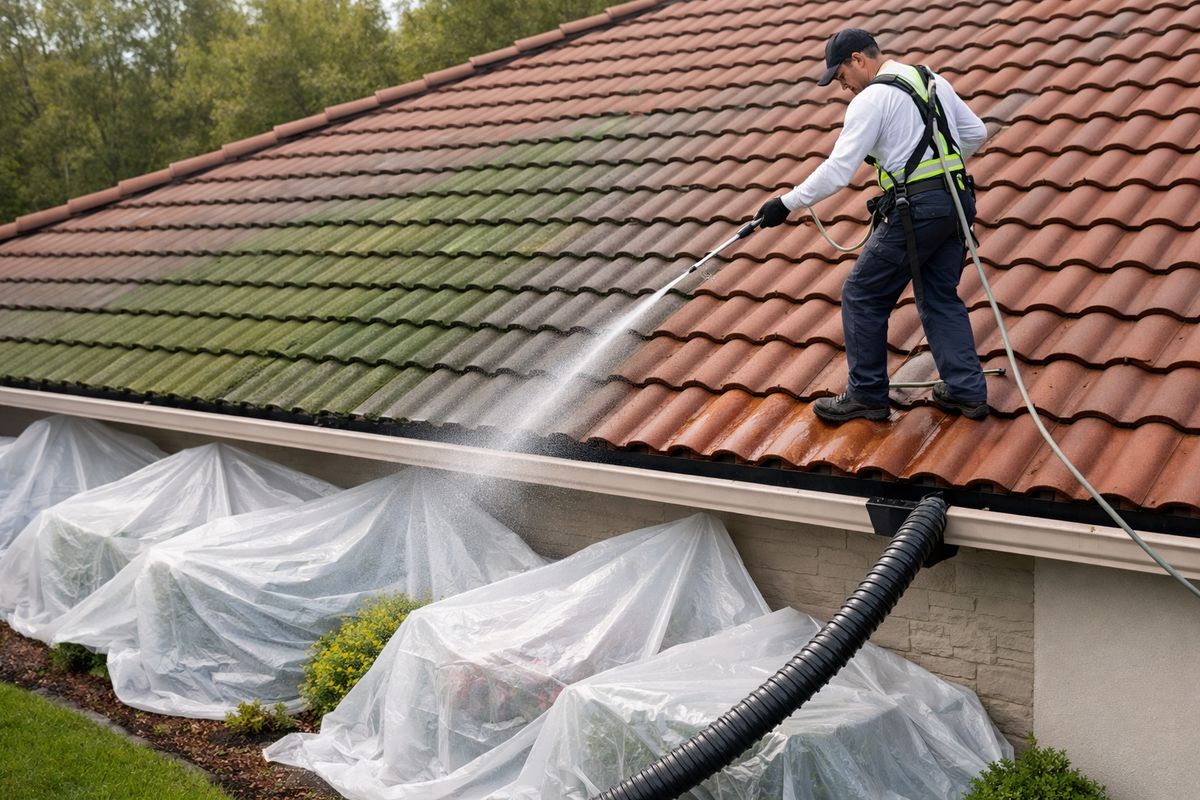
Debris Control, Trees, and Drainage
A lot of roof life gets decided by basic housekeeping. Not glamorous, but true.
Keep valleys and low spots clear
Valleys collect everything: water, leaves, twigs, seed pods, and roof debris from upslope areas. In Florida storms, valleys move a lot of water very quickly. If debris slows that flow, water can back up under tile edges or around flashing details.
Because valleys act like funnels, even a moderate blockage can create trouble faster than you would expect. A clean valley is one of the easiest ways to help a tile roof do its job.
Trim branches before they become roof damage
Branches that touch or overhang the roof too closely create four problems at once. They drop debris, rub tile surfaces, increase storm impact risk, and create shade that keeps the roof wetter longer. They also make excellent access routes for squirrels and other pests.
A practical rule from Florida roofing guidance is to keep branches about 6 feet from the roof when possible. That improves airflow, reduces debris, and lowers the chance that one summer storm sends a limb through your maintenance budget.
Maintain gutters and downspouts
Tile roofs still depend heavily on good drainage. Gutters should stay open, attached, and able to move water without backing up at the edge. Downspouts should discharge freely and away from the home.
Cleaning twice a year is a reasonable minimum on many Florida homes, and more often if you have heavy tree cover. Overflowing gutters can drive water backward under roof edges and contribute to fascia and underlayment damage. It is a small task with outsized payoff.
Check soffits, fascia, and drainage around the home
Roof maintenance does not stop at the tile line. Soffits and fascia show you how well water is being managed at the edges. Staining, peeling paint, soft spots, or mildew here often point to drainage problems above.
Also look at grade and splash zones around the house. If water dumps near the foundation or repeatedly soaks one exterior wall, drainage improvements may help protect both the roof edge and the rest of the building envelope.
Tile Roof Repairs: What Needs Fast Action
Not every roof issue is a same-day emergency. Some are. Knowing the difference saves money and stress.
Cracked tiles
A visible crack deserves repair sooner rather than later. Hairline cracks may seem minor, but Florida’s heavy rain can exploit even small openings. Obvious fractures, chips, or broken corners are more urgent because they can expose the layers below more directly.
Cracked tiles are also vulnerable to getting worse under foot traffic, wind, and thermal movement. What looks tiny in May can become a leak path by August.
Slipped, loose, or displaced tiles
These often show up after storms, poor fastening, or gradual movement over time. The problem is not just that the tile moved. It is what got exposed when it moved. Once underlayment is visible or less protected, UV and water start doing damage quickly.
This repair should not sit on your to-do list for weeks. Displaced tiles are the kind of small issue that creates larger failures during the next storm cycle.
Broken ridge caps and hip tiles
Ridge caps and hip tiles catch wind and weather because they sit at the high, exposed lines of the roof. Damage here can spread quickly because these areas help lock surrounding components together and protect key intersections.
When ridge or hip pieces break or loosen, water and wind can work into the roof more easily. Repairs in these sections are worth prioritizing.
Flashing repairs around chimneys, walls, and penetrations
Most persistent leaks are detail leaks, not field-tile leaks. Chimney bases, roof-to-wall intersections, vent pipes, skylights, and similar transitions are classic trouble spots. Rust, separation, poor original installation, and movement all show up here.
If you see staining around these areas inside the home, flashing should be high on the suspect list. And no, a blob of sealant is usually not the fix.
Underlayment failure beneath otherwise decent-looking tile
This is the sneaky one. The roof can look perfectly respectable from the driveway while the underlayment below is drying out, cracking, or failing at overlaps and penetrations. If leaks repeat in multiple areas, especially on an older roof with no dramatic tile damage, underlayment deserves serious attention.
That often changes the conversation from repair to larger system work. At that stage, it helps to understand when targeted fixes stop making sense and replacement planning starts.
Underlayment: The Part You Don’t See but Absolutely Depend On
If tile is the armor, underlayment is the shield underneath. You rarely see it, but during Florida storms it can be the difference between a near miss and a soaked attic.
What underlayment does on a tile roof
Underlayment is the backup water barrier installed on the roof deck beneath the tile. Because tile roofs shed water rather than sealing it out completely, some moisture can get underneath during wind-driven rain or around complex details. The underlayment is there to catch and redirect that water before it reaches the decking.
On lower-slope sections and high-wind exposures, underlayment matters even more. It carries a lot of responsibility during storm conditions.
Signs your underlayment may be failing
Recurring leaks in the same area are one clue. Multiple leak points on different slopes can be another. Brittle exposed material near edges, trouble after wind-driven rain, attic moisture without obvious tile breakage, and repairs that seem to “fix” one spot only for another to appear later all point toward underlayment issues.
Age matters too, but not in a simple way. A roof can be younger than expected and still have underlayment problems if installation was poor or weather exposure has been intense.
How Florida climate affects underlayment life
Heat cooks it. UV degrades any exposed edges. Humidity and moisture cycling wear it down over time. Storm-driven water tests every overlap and penetration seal. That is why tile roof lifespan in Florida is not just about how long the tile can theoretically survive. Real service life depends on everything below it.
In many Florida homes, tile may remain useful while underlayment needs replacement much sooner. Some roofing guidance puts tile system life in the 25 to 50 year range overall, while underlayment on long-lasting tile roofs may need renewal far earlier.
When maintenance turns into reroofing
There comes a point when repeated spot fixes cost more in money and frustration than a planned reroof or lift-and-relay project. Signs include frequent leaks, widespread brittle underlayment, repeated flashing failures, aging fasteners, or tile removal becoming necessary in multiple sections just to chase leaks.
That does not always mean replacing all the tile. Sometimes the smarter move is lifting salvageable tile, replacing underlayment and related components, then reinstalling tile where possible. If you are budgeting for that possibility, it helps to understand what drives Florida replacement pricing.
Flashing, Fasteners, and Roof Penetrations
Ask enough roofers where leaks start and you hear the same answer over and over: details. The metal parts and transition points often decide whether a tile roof stays dry.
Flashing types and where they fail
Valley flashing handles concentrated runoff. Step flashing protects roof-to-wall intersections. Counter flashing covers and deflects water over step flashing at vertical transitions. Drip edge protects eaves and rakes. Skylight and chimney flashing tie awkward shapes into the roof system.
These fail from rust, poor installation, movement, impact, incompatible materials, and simple age. Failure often begins at seams, corners, or places where water slows down and lingers.
Fastener corrosion in coastal and humid areas
Fasteners live hard lives in Florida. Heat, humidity, salt exposure, and repeated wet-dry cycles can corrode screws, nails, clips, and attachments. Once corrosion weakens those points, tiles and accessories may loosen gradually.
The frustrating part is that you often do not see the fastener first. You see the symptom: slipped tile, loose ridge piece, or movement at a penetration. By then, the hidden part has already been deteriorating for a while.
Vents, pipes, solar mounts, and other penetrations
Every roof penetration deserves regular checks because every penetration interrupts the clean flow of tile and underlayment. Plumbing vents, exhaust vents, satellite mounts, solar attachments, skylights, and equipment brackets all need proper flashing and sealing.
This matters even more after new equipment gets added. A beautiful tile roof can be compromised by one sloppy solar or vent installation. If your roof is aging already, adding rooftop systems without checking its condition first is asking for doubled labor later.
Why sealant alone is not a real repair
Sealant has a place in roofing, but it is not magic. If flashing is rusted, improperly lapped, loose, or badly detailed, covering the area in caulk is a patch, not a repair. The same goes for cracked penetrations or displaced tiles.
A proper fix restores the water-management detail. Sometimes that means new flashing. Sometimes it means resetting components. Sometimes it means addressing the underlayment below. But if the proposed solution sounds like “just seal it up,” be careful.
Ventilation and Energy Efficiency
Roof maintenance is not only about stopping leaks. It is also about helping the house stay cooler and drier.
How attic ventilation protects your roof
Good attic ventilation moves heat and moisture out of the attic space. That protects underlayment, decking, insulation, and even interior comfort. Without enough airflow, attic temperatures climb, moisture lingers, and roof materials age faster from below as well as above.
On a Florida home, that trapped heat can be punishing. Proper airflow helps moderate extremes and reduce the kind of hidden moisture problems that quietly shorten roof life.
Signs your ventilation is underperforming
A hot, stale attic is the most obvious sign. Others include mildew smells, condensation on surfaces, damp insulation, indoor rooms that stay warmer than the rest, and rising air-conditioning costs without another clear reason.
Poor airflow can also make leak diagnosis harder because moisture symptoms may come from condensation as well as rain intrusion. Either way, it deserves attention.
Insulation and ventilation work together
Ventilation alone cannot fix poor insulation, and insulation alone cannot vent trapped moisture. The two work as a pair. Insulation slows heat transfer into living spaces, while ventilation helps release heat and moisture from the attic.
In hot, humid climates, improving both can reduce cooling costs substantially. That is one of the few maintenance conversations that pays you back in comfort every single day, not just during storms.
Tile roofs and Florida heat performance
Tile performs well in hot climates because the shape and installation method can help reduce direct heat transfer. Some profiles create airspace beneath the tile, and lighter or reflective finishes can improve performance further. A well-maintained tile roof with good ventilation supports better indoor comfort than a neglected system with blocked airflow and deteriorating underlayment.
If you want the roof to work for efficiency, not just weather protection, upkeep matters more than the brochure ever says.
Hurricane Prep for Tile Roofs
Florida roof maintenance always circles back to storm prep. For tile roofs, the best hurricane plan starts before the forecast gets dramatic.
What to do before hurricane season starts
Schedule an inspection early, before contractor calendars fill up. Repair loose or broken tiles. Clear gutters and valleys. Trim branches that overhang the roof. Check penetrations and flashing details. Update your photo documentation from the ground and attic.
The timing matters. Waiting until a storm is named means you are competing with everyone else in town for help.
Last-minute checks before a named storm
Keep this list realistic. You are not reroofing the house 36 hours before landfall. You are reducing avoidable risk.
- Secure loose yard items
- Clear visible debris from drainage paths
- Photograph the roof and exterior
- Check attic access and flashlights
- Review contractor and insurance contacts
- Move valuables away from known leak zones
The point is to make post-storm assessment easier and reduce preventable water issues.
Protecting your home from wind-driven rain
Wind-driven rain exploits weak details. Valleys, penetrations, roof-to-wall intersections, skylights, ridge lines, and any known repair area deserve extra attention before storm season. The right protection comes from proper repair and component integrity, not shortcut sealant jobs.
If a contractor tells you hurricane prep is mostly just adding caulk here and there, keep looking.
What to do right after the storm passes
When conditions are safe, start inside. Check ceilings, walls, and attic spaces for moisture, drips, wet insulation, and musty smells. Then move outside for a ground-level visual review. Photograph everything before cleanup changes the scene.
If water is actively entering, temporary tarping may be needed, but wet, storm-damaged tile surfaces are not a DIY playground. Fast professional response matters most when interior damage is ongoing.
Coastal Florida Maintenance Tips
Living near the water changes the math. A tile roof on the coast usually needs more attention than the same roof farther inland.
Salt exposure changes your maintenance schedule
Salt speeds up corrosion and can shorten the life of metal details significantly. That means flashings, fasteners, clips, vents, and accessory components should be inspected more often and replaced sooner when wear appears.
Coastal homeowners often do best with at least annual professional checks plus additional storm-season reviews. The roof may still look fine from below while metal components are deteriorating out of sight.
Choose corrosion-resistant repair materials
When repairs happen, the material choice matters. Compatible, corrosion-resistant metals and fasteners are worth insisting on in marine environments. A cheap mismatch may “work” today and start rusting tomorrow.
This is one place where details really count. The repair material should fit the roof system and the environment, not just the invoice.
Watch for hidden metal deterioration
Corrosion often starts beneath or behind visible components. You may first notice rust streaks, loose tiles, staining around flashing, or instability at penetrations. By then, the hidden deterioration is already underway.
That is why coastal maintenance should include suspicion toward anything metal, even if the tile field looks beautiful.
DIY Tile Roof Maintenance: What’s Worth Doing Yourself
There are useful DIY tasks, and then there are fake-economy tasks that end up costing more. Stick to the first category.
Smart DIY tasks
The best do-it-yourself roof maintenance happens from safe places. Check attic spaces after storms. Keep a dated photo log from the ground. Watch for stains indoors. Monitor gutter flow during rain. Trim reachable branches from the ground or by using a qualified tree service for bigger cuts. Clear leaves from accessible drainage areas at the edges if you can do it safely from a ladder without stepping on tile.
Documentation is especially underrated. A phone camera and a simple note about when you first noticed a stain can save a lot of confusion later.
DIY tasks to avoid
Do not walk the roof unless you are trained and properly equipped for tile. Do not pressure wash it. Do not lift tiles to “peek underneath.” Do not improvise repairs with random caulk, roofing cement, mortar, or hardware store patch products. Do not attempt storm repair on wet, unstable surfaces.
The savings here are usually imaginary. One cracked tile can turn into ten, and one bad patch can hide the leak path while water keeps moving somewhere worse.
The tools that actually help
You do not need a giant toolkit. A few simple items go a long way:
- Binoculars
- Flashlight
- Moisture meter
- Phone camera
- Ladder stabilizer
- Maintenance log
That is enough to inspect intelligently, document changes, and know when to call for help.
Hiring the Right Roofing Contractor in Florida
A good tile roof can be damaged by bad workmanship faster than by age. So the hiring decision matters a lot.
What credentials matter
Look for proper Florida licensing, insurance, local code familiarity, and real tile-roof experience. Manufacturer familiarity helps too, especially when your roof has a specific profile or accessory system. In hurricane-prone areas, the contractor should understand wind-uplift expectations, flashing details, and current code-related requirements for repairs and reroofing.
This is not the place for a “my cousin knows roofs” arrangement.
Questions to ask before hiring
Ask what exactly will be inspected. Ask whether photos will be provided. Ask how broken tiles will be matched. Ask how underlayment condition will be evaluated without guessing. Ask whether flashing and penetrations are included in the scope. Ask what temporary repairs are truly temporary and what proper permanent repair involves.
Good contractors usually answer clearly. Vague answers are information too.
Red flags to notice fast
Be careful with pressure tactics after storms, vague scopes, verbal-only promises, or any pitch that treats caulk as a cure-all. If the proposal does not explain what is being repaired and why, that is a problem. If no documentation is offered, that is another one.
Florida has a huge roofing workforce, which is helpful, but volume does not equal quality. The state has more than 25,000 roofers, so choosing carefully matters.
Why tile experience matters more than generic roofing experience
Tile roofs are specialized. The materials are fragile in certain ways, repair methods differ from shingles, matching can be difficult, and improper foot traffic alone can create fresh damage. A contractor who is excellent with one roof type may still mishandle tile.
That is why it helps to focus on crews that specifically understand how to choose the right team for tile work, not just roofing in general.
Florida Building Codes, Insurance, and Documentation
Roof maintenance gets more complicated the moment repairs intersect with code, storm claims, or larger system issues. A little documentation goes a long way.
Why code compliance matters during repairs
Some repairs are simple. Others can trigger code-related requirements depending on scope, location, and system condition. Florida roofing work also sits in a high-wind context, so attachment, underlayment, flashing, and deck details may matter more than owners expect.
Your contractor should know current Florida standards and be able to explain when a repair remains a repair and when broader updates are required. If someone shrugs off code questions, that is not reassuring.
Documenting roof condition before and after storms
Photos help before anything goes wrong, not just after. Take wide shots of each roof slope from the ground, close-ups of edges and valleys where visible, and attic photos showing dry conditions. After storms, repeat those shots and add any visible damage or moisture findings.
That paper trail makes insurance conversations cleaner and gives repair crews a before-and-after story instead of a guessing game.
Understanding repair vs. replacement conversations
Age, underlayment condition, number of leak locations, tile availability, storm damage extent, and code implications all shape the repair-versus-replacement discussion. A newer roof with localized tile damage may be an easy repair. An older roof with recurring leaks across multiple areas may be approaching a larger project even if the tile surface still looks acceptable.
This is where owners often get frustrated, because the roof “looks okay.” But looks are only one part of the diagnosis.
Keep a simple roof file
Store inspection reports, invoices, warranty documents, permit records, roof photos, and dates of major storms in one place. Digital is fine. A folder in cloud storage works just as well as a physical binder if you keep it updated.
It sounds boring. It is also incredibly useful when a leak appears two years later and you need to know what was repaired, by whom, and with what warranty coverage.
Tile Roof Maintenance Costs in Florida
Sooner or later, every roof conversation gets to money. Fair enough.
What routine maintenance usually includes
Routine maintenance often includes a visual inspection, attic review, debris removal, drainage checks, minor tile replacement, flashing touch-ups where appropriate, gutter service, and recommendations for further repair if needed. Cleaning may be separate, especially if biological growth or heavy debris buildup requires dedicated work.
The exact scope changes with roof age, access, pitch, coastal exposure, and storm history.
Typical repair cost ranges
Florida roof repairs overall often fall in the $400 to $3,500 range, with tile repairs tending to run higher than simpler roofing materials because the labor is more specialized and material matching can take more work. A single tile replacement is one thing. Tracking down a flashing leak beneath several courses of tile is another.
If you are facing bigger decisions about replacement rather than maintenance, it helps to compare what Florida homeowners usually pay for tile projects so the estimate in front of you has context.
Why early repairs are cheaper than waiting
This is one of the few roof rules that is almost always true. Early repairs are cheaper. A small tile or flashing issue is manageable. Interior water damage, mold cleanup, rotted decking, and emergency service are not.
Preventive maintenance also costs less than reactive maintenance over time. One industry source cited a rough comparison of about $0.04 per square foot for preventive programs versus $0.15 per square foot for reactive care. The exact number is less important than the pattern: fixing problems early costs less.
Budgeting for long-term tile roof care
The smartest way to budget is to stop thinking only in emergencies. Tile roofs reward planned spending. Set aside funds yearly for inspection, debris control, minor repairs, occasional cleaning, and eventual larger system work such as underlayment replacement.
That approach feels less dramatic because it is. Roof neglect creates drama. Maintenance mostly prevents it.
How Long a Florida Tile Roof Can Last
Tile lasts a long time, but not forever, and not on promises alone.
Real-world lifespan for concrete and clay tile
In Florida, many tile roof systems last roughly 25 to 50 years, depending on installation quality, location, ventilation, storm exposure, and maintenance. Concrete tile commonly lands in the 30 to 50 year range, sometimes longer. Clay tile can last much longer in theory, even into the 50 to 100 year range or beyond in some cases.
But the tile itself is only part of the story. Underlayment often needs replacement much earlier than the tile field.
If you want a more product-specific look, Top Hat Roofing’s tile roof overview gives a useful snapshot of how clay and concrete tile are generally positioned for Florida homes.
What shortens roof life
Storm exposure is a big one. So are poor ventilation, bad flashing work, repeated foot traffic, skipped inspections, delayed leak repairs, and clogged drainage. Poor workmanship can cut life expectancy in half. That sounds dramatic because it is.
A roof does not usually fail from one bad day. It fails from many ignored signals.
What extends roof life
Routine inspections, prompt tile repairs, clean valleys and gutters, strong ventilation, quick post-storm follow-up, and quality craftsmanship all extend roof life. The roof does not need perfection. It needs consistency.
That is good news, because consistency is much cheaper than starting over.
Special Cases: Older Homes, Historic Tile, and Add-Ons
Some roofs need a more careful approach than the average maintenance checklist suggests.
Maintaining older Florida homes with tile roofs
Older homes may have aging decking, outdated underlayment, older flashing methods, and hidden repairs layered over decades. A minor leak fix can uncover broader issues once tile is lifted and the actual substrate is exposed.
That does not mean panic. It means older tile roofs deserve realistic expectations. Sometimes the visible problem is only the first problem.
Historic clay tile roofs
Historic clay tile should be preserved when possible, not casually swapped out for modern look-alikes that do not match in material, profile, or performance. Preservation guidance for historic clay roofs stresses matching salvaged or appropriate replacement tile and using qualified professionals with relevant experience.
If your home has original or historically significant clay tile, treat repair like restoration, not just patchwork. The wrong fix can damage both value and appearance.
Solar panels, skylights, and rooftop equipment
Every add-on increases complexity. Solar mounts, skylights, satellite hardware, and mechanical equipment introduce penetrations and new flashing details. If the roof is already nearing major maintenance or replacement, adding solar first can become expensive later because removal and reinstallation add cost.
A simple rule helps: get the roof condition assessed before adding rooftop equipment. If the roof needs major work soon, do that first.
A Practical Year-Round Tile Roof Maintenance Checklist
A guide this long should end up useful, not just informative. So here is the part worth saving.
Monthly checklist
Use this as a quick habit, not a weekend project.
- Scan ceilings for stains or bubbling paint
- Check attic for musty smells or damp spots
- Look for tile pieces on the ground
- Watch gutters during or after rain
- Scan valleys and roof edges with binoculars
- Note any new discoloration or movement
Before hurricane season checklist
This is the prep list that actually matters.
- Schedule a professional inspection
- Repair loose, cracked, or missing tiles
- Clear gutters, downspouts, and valleys
- Trim back overhanging branches
- Photograph roof slopes and attic areas
- Review warranties, permits, and contractor contacts
- Confirm flashing and penetrations are in good shape
After-storm checklist
Do this as soon as conditions are safe.
- Check ceilings and upper walls for stains
- Inspect attic for drips, wet insulation, or odors
- Scan roof from the ground with binoculars
- Photograph all visible damage
- Look for fallen tile fragments
- Check gutters and drainage paths
- Call for professional help if tiles shifted, flashing bent, or water entered the home
Annual maintenance checklist
Once a year, make it more thorough.
- Get a professional tile-roof inspection
- Review flashing, penetrations, and valleys
- Check attic ventilation and insulation performance
- Clean biological growth if needed
- Clear and service gutters and downspouts
- Update your roof file with photos and invoices
- Budget for any recommended repairs before storm season
Frequently Asked Questions About Tile Roof Maintenance
How often should a tile roof be inspected in Florida?
At minimum, once a year and after any major storm. If your home is coastal, older, heavily shaded, or has had previous leaks, twice-yearly checks are a smart move.
Can you walk on a tile roof?
Not as a casual maintenance habit. Tile can crack, shift, or loosen under foot traffic, and fall risk is real. Ground-level inspections, attic checks, and professional service are the safer approach.
Is pressure washing safe for tile roofs?
Usually no. High pressure can crack tiles, damage coatings, and force water under laps. Soft washing or other low-pressure professional cleaning methods are generally safer.
How do you know if tile or underlayment is the real problem?
Visible broken or slipped tiles point to surface damage, but recurring leaks on a roof that still looks decent often suggest underlayment or flashing trouble. If leaks keep returning or show up in multiple areas, the issue is often deeper than the tile alone.
How much does tile roof maintenance cost?
Routine maintenance is usually modest compared with repair or replacement. Florida roof repairs commonly range from a few hundred dollars to a few thousand, with tile work often costing more than asphalt because the labor and matching are more specialized.
How long does a tile roof last in Florida?
Many Florida tile roof systems last 25 to 50 years, while clay tile can last much longer in ideal conditions. The actual outcome depends heavily on installation quality, storm exposure, coastal conditions, ventilation, and how quickly repairs are handled.
Your Next Best Step
Try one simple thing this week: do a 10-minute ground-level check after the next rain. Look at your ceilings, scan the roof with binoculars, and pay attention to valleys, gutters, and anything that seems just a little off. That small habit catches more Florida roof problems than most people realize, and if something does stand out, booking a tile-specific inspection right away is the smartest move you can make.